Troubleshoot a deployment
Start with the Environment canvas or these three commands:
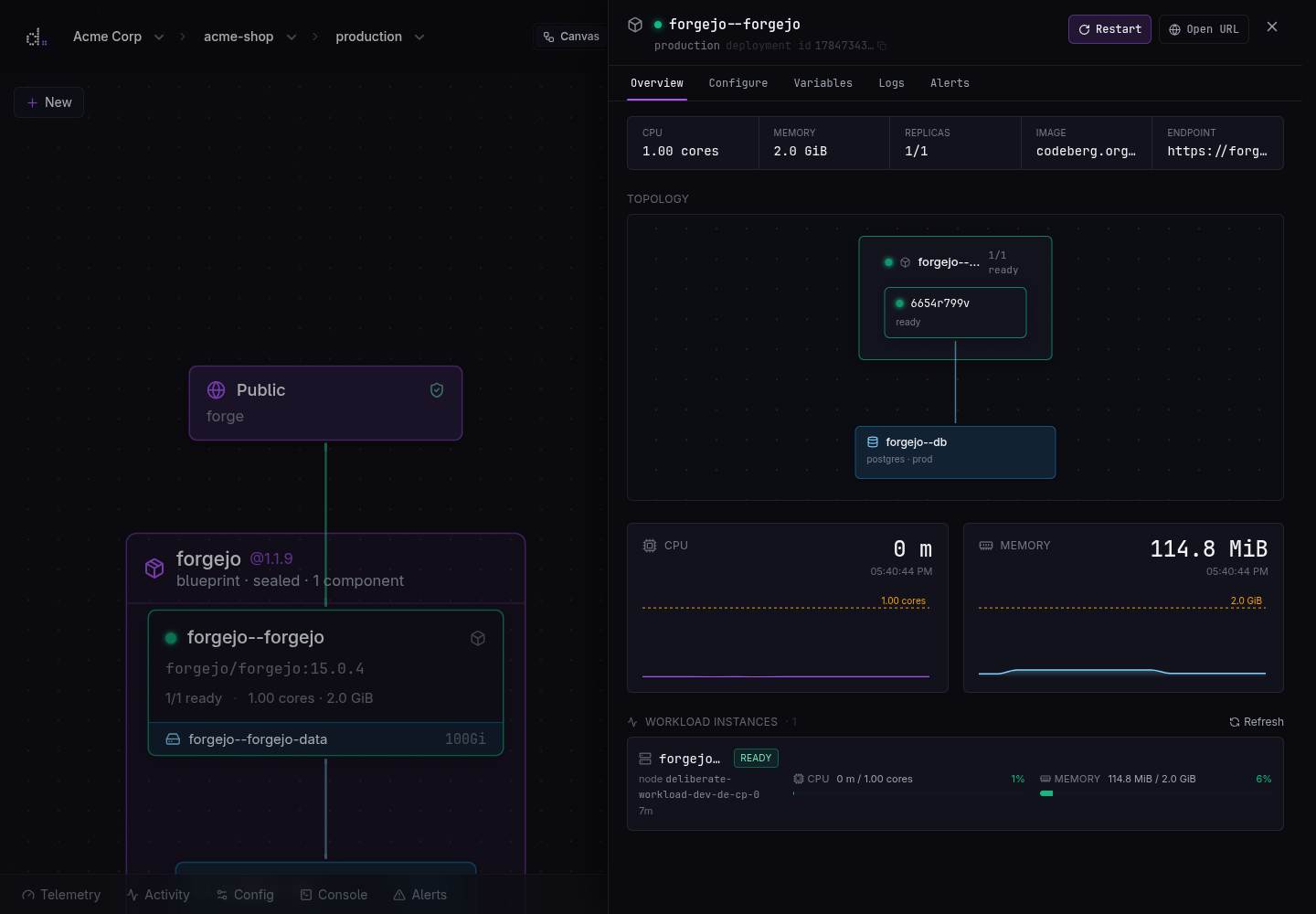
deliberate statusdeliberate components list --env productiondeliberate deployments list --env productionThe Environment canvas shows the same topology. Select the unhealthy Component or Blueprint node to inspect its rollout and operational controls.
Find where the apply failed
Section titled “Find where the apply failed”deliberate apply validates the complete desired state before reconciling it
and streams each phase as it happens. A validation or unresolved-secret error
means that desired state was rejected; correct the YAML or set the named secret
and apply again. A rollout error means a revision was recorded but one or more
runtime resources did not become ready. The previous process may still be
serving traffic while the replacement is unhealthy, depending on how far the
rollout progressed.
For a rollout failure, inspect the failed Component:
deliberate deployments list --env productiondeliberate components list --env productiondeliberate logs --env production --component appCompare the image, command, port, health check, required secrets, and dependency
bindings with the application. Fix desired state and apply again; apply is
idempotent, so recovery does not require deleting the Environment first.
Inspect logs and metrics
Section titled “Inspect logs and metrics”deliberate logs --env production --component appdeliberate metrics --env production --component appUse exec only when observation is insufficient:
deliberate exec --env production --component app -- shIf a public request returns 403 or 413 without appearing in the component logs, review Web traffic protection. The response may have been produced by the gateway before the request reached the application.
Check the deployed image
Section titled “Check the deployed image”The platform scans images pushed to the deliberate. registry and refreshes the results as its vulnerability database changes. Inspect the status and severity summary for an image, then open the package-level findings when needed:
deliberate images list --project hello-javadeliberate images vulns hello-java:1.0.0The detailed report names the affected package, installed version, severity, and available fixed version. A newly pushed image may report that scanning is still in progress.
Review and silence alerts
Section titled “Review and silence alerts”Alert policy belongs in desired state so it follows the resource and
Environment. The console edits the same operational policy for a deployed
Blueprint. Use deliberate alerts events to inspect history and deliberate alerts silence for a bounded operational silence. Read Configure
alerts for the available signals, thresholds, recipients,
testing, and silence workflow.
Roll back application configuration
Section titled “Roll back application configuration”Choose a previous deployment revision when correcting the current YAML would take longer than restoring known application configuration:
deliberate deployments rollback --env production <revision>deployments rollback first prints the resources it will keep, restore, add,
or remove. After confirmation it writes a new revision derived from the chosen
historical revision and reconciles the Environment to it. The historical record
is never mutated. Protected Environments require their name to be typed; use
--force only in an already-reviewed automation path.
Rollback restores authored application state: images, configuration, routes, and the declared resource topology. It does not rewind the contents of a database, volume, or bucket. Use the resource’s backup and restore workflow for data recovery. If a bad application revision also wrote incompatible data, decide on application and data recovery together before acting.
Recover data
Section titled “Recover data”Database tiers and volume backup policies determine which recovery points are available. An on-demand database backup is a separate runtime action:
deliberate databases backup postgres --env productionRead Databases for database backup and restore behavior, Volumes and backups for snapshot policies, and Data protection for the encryption and isolation model.